
What is Regla?
Regla is one of several accounting integrations available in Manor. When you select Regla as your invoicing integration, Manor can post invoices to your Regla accounting system.
Why Connect to Regla?
Using the Regla integration helps you:
- Automate invoicing - Post invoices to your accounting system directly from Manor
- Reduce manual entry - Eliminate double data entry between Manor and Regla
- Maintain consistency - Keep invoice data synchronized between systems
Selecting Regla as Your Invoicing Integration
To use Regla for invoice posting:
-
Navigate to Management → Firms from the main menu.
-
Click on your firm to open its settings page.
-
Scroll to the Invoicing setup section and click Edit.
-
In the Invoicing integration dropdown, you will see the available options:
- Manor invoicing
- DK (XML file export)
- DK
- Regla
- Payday
- Business Central invoicing
-
Select Regla from the dropdown.
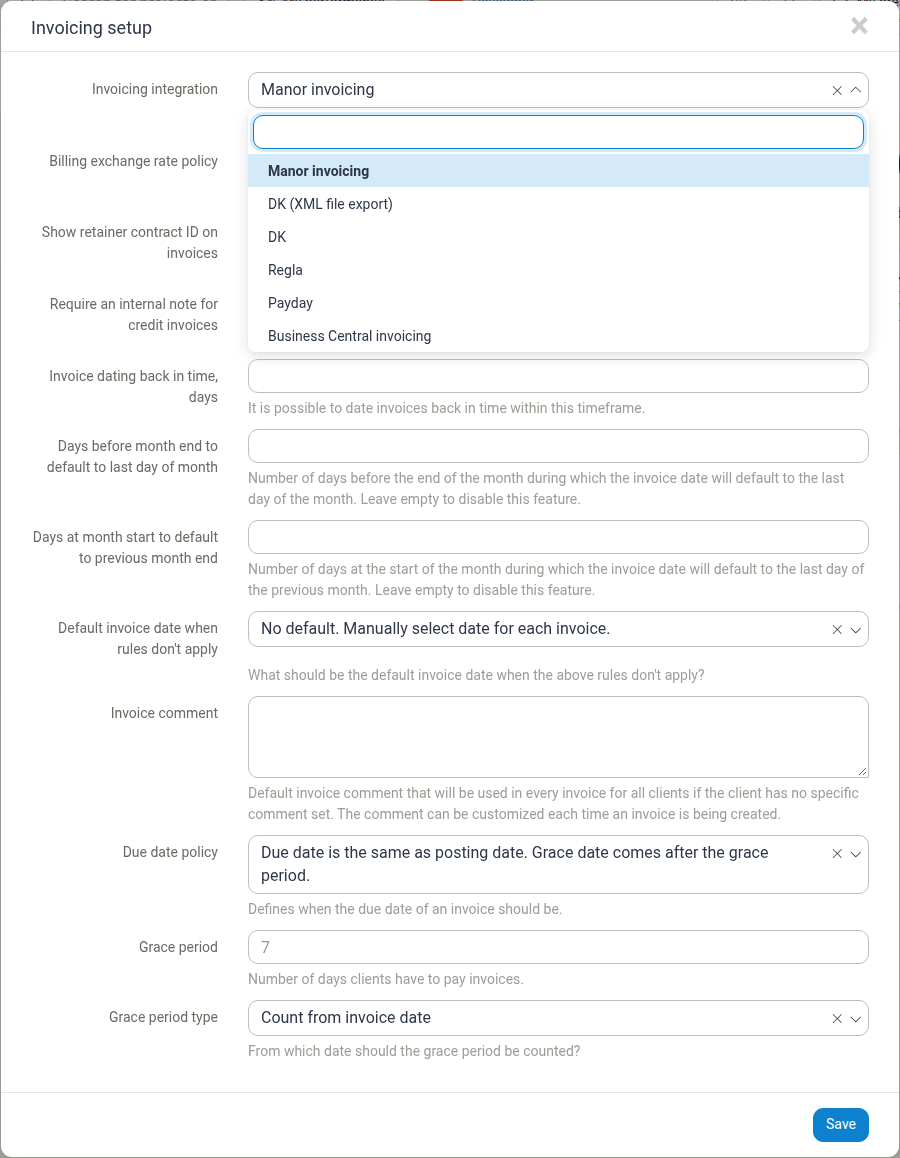
- Click Save to apply the selection.
Once saved, a new Regla settings group appears on the firm settings page, where you enter the connection credentials described below.
Regla Settings
The Regla settings group contains the credentials Manor uses to connect to your Regla account:
- Username — the username of a user in your Regla accounting software. It is recommended that you create a dedicated user account for the integration.
- Password — the password for that Regla user. The value is kept hidden after it is saved.
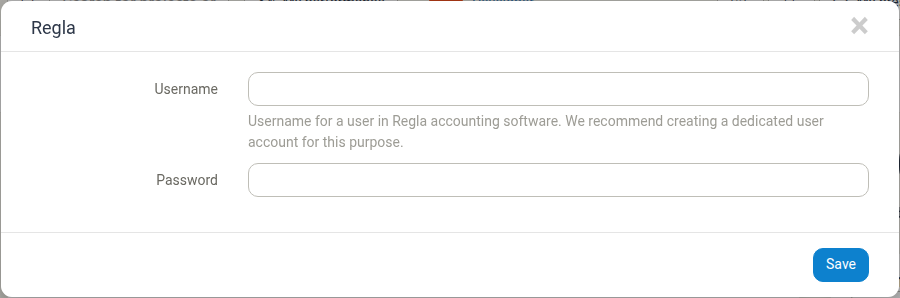
Manor uses these credentials to open a connection to the Regla web service whenever it needs to create, read back or download an invoice. If the credentials are missing or wrong, invoices cannot be created in Regla.
Prerequisites
Before connecting:
- An active Regla accounting software account
- A dedicated Regla user account (recommended)
- Administrator access to your Manor firm settings
How Invoices Are Handled
Once the Regla integration is connected and configured:
- The invoices you choose to create in Regla are posted electronically to Regla from Manor.
- Regla assigns the invoice number, which is then stored on the Manor invoice.
- The client's national ID is used to match the invoice to the correct Regla customer, so the client's national ID in Manor must be identical to the corresponding customer number in Regla.
- A product number is required on every invoice line.
Issuing an Invoice to Regla
This section describes what happens from the moment you issue an invoice after the Regla connection has been configured. The invoicing form itself is the same as for any other integration — see Invoices for the full step-by-step walkthrough of building an invoice from balances. The paragraphs below focus on what is specific to Regla.
Issuing is the same form, with a "Create this invoice in Regla" option
When Regla is your invoicing integration, you still create the invoice in Manor in the usual way:
-
Go to Billing and start a New invoice from a balance (or from a project).
-
Pick the billable items, client/payer, issue date, layout and period.
-
In the footer of the invoice form you will see a checkbox, Create this invoice in Regla. It is ticked by default.
- Ticked — issuing the invoice also posts it to Regla.
- Unticked — the invoice is created in Manor only and is not sent to Regla.
-
Click the primary submit button. Which button you see (Send invoice now, Send invoice during office hours, or Create invoice) is decided by your firm's invoice delivery settings, not by this checkbox.
This is different from some other integrations: for Regla the push is opt-in per invoice through this checkbox, not an unconditional side effect of issuing. A Regla invoice can therefore exist in Manor with no matching Regla invoice if you deliberately untick the box.
What Manor does when the box is ticked
In the background Manor will:
- Look up the matching customer in Regla by the client's national ID, and create the customer if it does not already exist.
- Build the invoice in Regla, including its lines (description, quantity, price, discount and VAT percentage), invoice date and, for foreign-currency invoices, the exchange rate.
- Post the invoice to Regla.
- Read back the invoice number from Regla's response and store it on the Manor invoice, so Manor and Regla refer to the same invoice number.
If the invoice is still open and has no invoice number yet (for example it was saved with the box unticked, or your firm uses invoicing proposals), the invoice's own page shows a Create this invoice in Regla button. Clicking it posts that already-created invoice to Regla without re-creating it in Manor. Once the invoice has a Regla invoice number the button is no longer offered.
Invoice numbering
Regla assigns the invoice number. Manor stores the number returned by Regla on the invoice, so the number you see in Manor is the same number used in Regla. This is why the Prefix and Next invoice number settings under Manor invoicing do not apply when Regla is the integration — numbering is governed by Regla, not by Manor.
An invoice that has not yet been posted to Regla has no invoice number. Manor uses this ("no invoice number yet") to know whether the invoice still needs to be created in Regla, and to decide whether the Create this invoice in Regla button is shown.
Product numbers are required
Regla requires a product number on every invoice line. If you have not configured these, Manor warns you when you try to issue the invoice and does not post it, for example:
This setting has not been set yet: Product number for time
(and equivalent messages for travel, products, per diem and each expense VAT rate). Set the product numbers before invoicing in Management → Pricing → Settings (the Rate settings page), under the Product numbers group (product numbers for time, travel, products, per diem, each expense VAT rate, and for retainer balances and amounts).
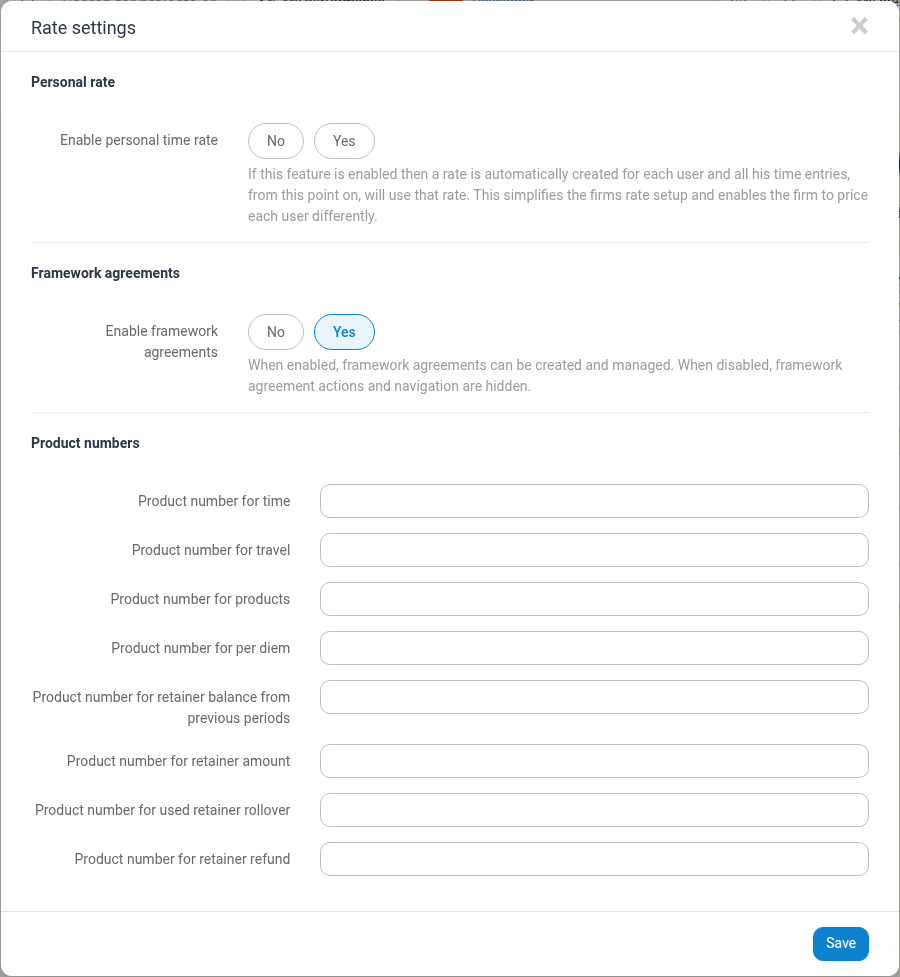
A product number can also be set on an individual rate, and per department, if you need finer control.
National ID matching
The client's national ID must exist and match the customer number in Regla for Manor to attach the invoice to the correct Regla customer. Regla requires a 10-digit national ID. For foreign clients that do not have a valid national ID, use any 10-digit number that starts with 99, for example 990000-0001. The client's national ID must be the same in Manor and in Regla, otherwise the invoice may be created against the wrong customer or rejected.
Zero-value invoices
If the selected items total zero, Manor still lets you create the invoice but shows a warning. This is a general Manor warning rather than one that is specific to Regla:
Current invoicing integration does not allow invoices with total value 0. You can still create the invoice, but it will not be sent to the invoicing integration.
What the user sees after issuing
- On success, the invoice is created in Manor and appears in the Billing → Invoices list, carrying the invoice number returned by Regla. Manor shows a confirmation such as "Invoice successfully sent to Regla".
- From the Invoices list you can open the invoice, download it, credit it, and track its status.
- If Regla rejects the invoice, Manor does not issue it. Manor shows an error instead — for example "Accounting software returned an error: …", or, when the client's national ID is invalid, a message explaining that Regla requires all clients to have a 10-digit national ID and that the client's number must be the same in Manor and Regla. The most common causes are a missing or incorrect username/password and a national ID that Regla cannot match. Correct the cause and try again.
Downloading the invoice
Because the invoice also lives in Regla, Manor can download the invoice document from Regla rather than from Manor's own layout. Use the invoice's download action on the invoice page. The downloaded PDF is the Regla version of the invoice.
Credit invoices
When you credit an invoice in Manor while connected to Regla, Manor creates the corresponding credit invoice in Regla. The credit invoice is linked to the original Regla invoice, and the credit invoice number is read back and stored just like a normal invoice number.
Invoice Status and Payment Synchronisation
The Regla integration does not synchronise payment status back into Manor. Unlike DK and Payday (see Connecting to DK), Regla does not report whether its invoices are settled, so Manor does not automatically mark Regla invoices as paid, partially paid or unpaid.
In practice this means:
- Manor does not track the paid/unpaid status of invoices posted to Regla, and does not show a payment-status column for them.
- If your firm relies on Regla, treat Regla as the place where payment status is recorded, and reconcile payments there.
- When you create a credit invoice, Manor records the credit (and both the original and the credit invoice are treated as settled) — this is the one case where a Regla invoice's status changes in Manor.
Because the invoice number is shared between Manor and Regla, the invoice you see in Manor always corresponds to the same invoice in Regla, which makes it straightforward to look up its payment status in Regla.
Could not be verified in this environment: in this test instance the firm settings page (
/management/firm/{id}/settings) returned a "Page or file not found" error, so the steps that open the Invoicing setup and Regla dialogs from that page could not be clicked through end to end. The two dialogs themselves were verified directly: the Invoicing setup dialog (title Invoicing setup,Invoicing integrationdropdown listing Manor invoicing, DK (XML file export), DK, Regla, Payday and Business Central invoicing) and the Regla credentials dialog (title Regla,UsernameandPasswordfields, with the helper text shown above). No valid Regla account/credentials were available, so the successful end-to-end posting to a real Regla account (a Regla-assigned invoice number coming back, and a download from Regla) could not be reproduced here; those details are based on how Manor is wired to Regla. Verify the successful path in your own Regla account before going live.
Related articles
- Invoices — the full invoice workflow (balances, form, preview, issuing, delivery, paid/unpaid tracking).
- Invoice Setup — invoicing integration, numbering, delivery and default invoice terms.
- Invoice Delivery — how delivery attempts and failures are tracked.
- Balances Overview — the billable balances you create invoices from.
- Connecting to DK — the DK integration and its payment-status synchronisation.
- Billing — overview of the whole Billing section.
Best Practices
Set up a dedicated Regla user
Use a dedicated user account in Regla for the integration and store its password securely.
Set product numbers for every billable type
Regla requires a product number on each invoice line. Configure Product number for time, travel, products, per diem and each expense VAT rate before you issue your first invoice.
Match national IDs with Regla
Make sure each client's national ID is the same in Manor and Regla, and remember that foreign clients need a 10-digit number starting with 99.
Test before going live
After configuring the integration, create a test invoice with the Create this invoice in Regla box ticked to verify that it reaches Regla correctly and that the Regla invoice number comes back.
Reconcile payments in Regla
Because Manor does not sync payment status from Regla, keep Regla as the source of truth for whether Regla invoices have been paid.